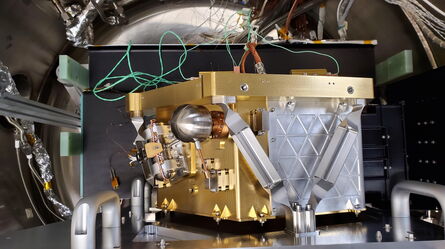
Standards-Compliant Environmental Testing
Environmental tests must fully comply with international standards and customer specifications. Norms require strict setup definitions, exact profile execution, and complete documentation — including intermediate and sub-results — to ensure traceability across environmental tests, mechanical stress testing, and shock and vibration testing.
Our Environmental Testing solutions offer all configuration options needed for standard-compliant execution. Every required parameter, tolerance, ramp, and limit is explicitly definable. Intermediate results and sub-results are automatically stored. Configuration details such as fixture mass, mounting conditions, DUT specifications, and profile definitions are preserved in the project, enabling fully compliant reporting for environmental simulation, thermal testing, mechanical testing, product environmental testing, and transport simulation.
Complex Mixed Modes
Mixed-mode tests — such as Sine-on-Random (SOR), Random-on-Random (ROR), Sine-on-Random-on-Random (SOROR), and Multi-Sine — are sophisticated to define and require precise control. These profiles are essential for realistic operational environments and structural durability assessments.
Our platform enables engineers to define and execute all mixed-mode profiles with exceptional precision. Sinusoidal and random components can be combined and adjusted in real time, allowing nuanced excitation that matches real-world operating environments. Advanced control algorithms maintain profile accuracy while handling multiple PSD sections and multi-tone inputs. This ensures that mixed-mode environmental simulations run reliably, consistently, and with full compliance to required stress levels.
Safety, Notching & Controlled Shutdown
Large shakers, heavy fixtures, and demanding test profiles create safety challenges. Without proper control limits, notching, and shutdown mechanisms, both equipment and DUTs may be exposed to overload conditions.
The m+p Environmental Testing platform offers robust, fully configurable safety mechanisms. Notching and vector-notching ensure that resonant peaks are controlled within safe limits, preventing excessive structural excitation. Abort and warning thresholds—based on RMS or peak values—enable engineers to maintain full control over their test environment. A controlled shutdown ramp protects both the shaker system and the DUT during emergency stops or profile transitions, creating a safe and predictable testing environment even under high mechanical load.
Sequencing of Complex Test Campaigns
Environmental test plans often combine multiple vibration modes and environmental conditions into long sequences, for example Sine followed by Random, Shock, SRS, or further vibration steps. Manual setup is error-prone and inefficient, especially in test houses managing numerous sequences daily.
With VibUtil, complex environmental test sequences can be built intuitively. Engineers can define multi-step workflows that include Sine, Random, Shock, SRS, Mixed Modes, or temperature cycle tests, and combine them into a single automated campaign. Profile transitions are handled seamlessly, while parameter inheritance ensures consistent conditions across the entire sequence. This allows laboratories to execute long, multi-step qualification tests with high reliability and minimum operator intervention.
Integration of Climatic Chambers & External Hardware
Environmental tests often combine vibration with additional stimuli, such as rapid temperature cycling or power supply modulation. Without a coordinated system, synchronising climatic chambers, signal lamps, power electronics, or external sensors can be difficult.
Our Environmental Testing platform integrates external devices directly through digital inputs and outputs. Climate chambers, signal lights, power supplies, and other equipment can be synchronised with vibration profiles for combined environmental simulation. This seamless interaction enables engineers to run complex tests—such as vibration with simultaneous thermal cycling or power application—within a single, unified workflow, maintaining full traceability of all environmental parameters.
Monitoring, Automation & Multi-Shaker Laboratories
Large test facilities operate multiple vibration systems simultaneously. Engineers need remote visibility, automated control, and high-level status information to maintain efficiency and safety across all test stations.
CODA provides centralised, real-time monitoring of all connected test systems. Engineers can view acceleration levels, running profiles, current status, and safety indicators from any location. For complete automation, the REST API makes it possible to create, start, modify, and analyse tests programmatically. This is particularly valuable for laboratories running high volumes of environmental tests or long-duration qualification programs, allowing them to scale operations without increasing personnel workload.
HALT & HASS (Highly Accelerated Life Test / Stress Screen)
HALT and HASS require applying combined stresses—rapid thermal transitions, broad temperature ranges, and high-level broadband vibration—to uncover early-life failures, destruct limits, and latent defects. These tests demand precise control, very fast transitions, and absolutely reliable documentation.
Our solutions fully support HALT and HASS methodologies. During HALT, temperature and vibration stress levels can be increased independently or in combination to determine operational limits, destruct limits, and multiple failure modes. For HASS, all stresses can be applied simultaneously, with continuous temperature ramping and vibration excitation based on the limits identified in HALT. The platform manages these combined stresses reliably, while CODA and the REST API enable automated documentation, monitoring, and long-term reliability analysis. This creates a robust infrastructure for effective HALT/HASS reliability testing.
Feasibility Analysis & Technical Limits
Engineers must verify before testing whether a vibration or environmental profile is feasible for the shaker, fixture, and DUT mass. Without proper feasibility checks, tests may fail prematurely or exceed equipment limits.
Our platform offers a detailed feasibility analysis that evaluates shaker displacement, velocity, force limits, and expected control behaviour against DUT and fixture characteristics. Engineers can make informed adjustments before running the actual test, ensuring that demanding profiles—such as shock and vibration testing, climatic testing, or highly accelerated life testing—can be executed safely and successfully.
Raw Data Recording & Deep Analysis
Environmental tests often require verification of profile performance or deeper insight into structural behaviour. Time-domain data is critical for examining shock decay, evaluating control accuracy, or understanding DUT response.
High-rate raw data can be recorded in parallel with the vibration control loop and imported directly into the m+p Analyzer. Engineers can perform detailed ODS evaluations, frequency-domain analysis, or shock decay assessments. This seamless integration between vibration control and advanced analysis tools gives test facilities the ability to investigate issues in depth and generate fully traceable environmental test reports.
Environmental Simulation – FAQ
What is sine testing?
Lorem ipsum dolor sit amet. Vel quis assumenda ad iusto cupiditate nam quia nemo in Quis dolorem. Ex rerum amet qui corporis odit est exercitationem sequi.
What is a sine wave vibration?
Lorem ipsum dolor sit amet. Vel quis assumenda ad iusto cupiditate nam quia nemo in Quis dolorem. Ex rerum amet qui corporis odit est exercitationem sequi.
What is better, sine or random?
Lorem ipsum dolor sit amet. Vel quis assumenda ad iusto cupiditate nam quia nemo in Quis dolorem. Ex rerum amet qui corporis odit est exercitationem sequi.
What are the limitations of sine vibration testing?
Lorem ipsum dolor sit amet. Vel quis assumenda ad iusto cupiditate nam quia nemo in Quis dolorem. Ex rerum amet qui corporis odit est exercitationem sequi.