Vector-Notching

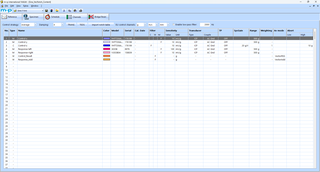
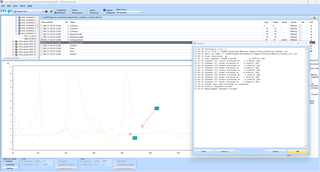
Vector Notching extends the classic Notching principle by taking into account not only the magnitudes but also the directions of the vector variables. This opens up new, powerful possibilities for targeted limiting - especially in complex test setups with multiple sensors. This technology is essential for applications such as force-limited vibration testing, where direction-dependent control of the load is required to ensure realistic and component-friendly tests.

Vector Notching by m+p international 

Efficiency

Digital vector addition makes setup simple and eliminates manual calculations. This ensures fast configuration and smooth workflows, even in complex test scenarios.

Safety

Protect both specimen and shaker system from overload: Vector sum notching and momentum notch (overturning moment) provide essential safeguards in force-limited vibration testing.

Flexibility

Extended notch control through vectors gives you more freedom in defining precise protection strategies. Whether on individual channels or combined signals, you adapt the system exactly to your needs.

Quality

Achieve precise and reliable results with advanced vector-based notching. From overall acceleration to overturning moments, Vector Notching ensures transparent and reproducible test conditions for maximum confidence in your data.

Lorem ipsum dolor sit
consectetuer
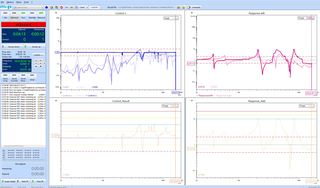
Extended notch control via vectors

Vector Notching enables limitation based on vector variables, i.e. resulting forces or accelerations across multiple directions. Instead of considering individual channels separately, the overall load is determined - for more precise and realistic control in demanding test setups.
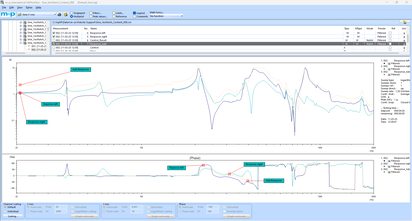
Vector sum - essential for force limited vibration testing

The calculation of the vector sum is a central element in Force Limited Vibration Testing (FLVT). Several force or acceleration sensors are combined mathematically in order to provide a realistic representation of the total load actually acting on the specimen. FLVT can only be implemented safely and reliably using this method.
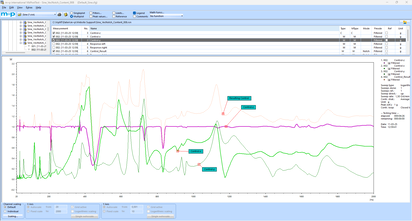
Notches on the overall acceleration

Vector Notching can be used not only for force channels, but also for acceleration channels - for example to limit the overall acceleration of a component. The combined consideration of all directions effectively protects the specimen from overstressing in multi-axial test environments.
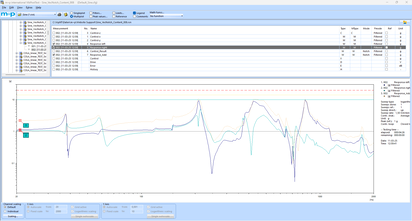
Momentum notch (“overturning moment”)

Overturning momentum notching (also known as “momentum notch”) is used to calculate the torque generated by forces at defined measuring points. This torque can lead to critical loads on the shaker system and slip table, especially during sinusoidal tests. Significant mechanical damage can be prevented by targeted Notching to this value.
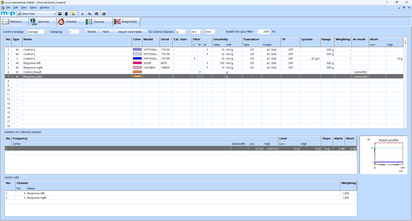
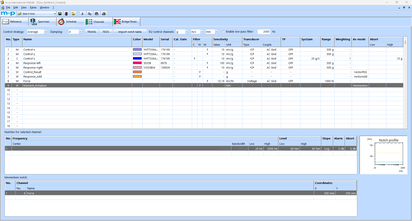
Digital vector addition

Vector Notching enables the digital addition of multiple sensors within the software - without any additional hardware. This eliminates the need for analog cabling, while at the same time ensuring that all sensors operate within their permissible limits. The calculation is carried out in real-time.

A cube-shaped satellite with solar panels is displayed on a metal platform, surrounded by red wiring.

Upgrade to
VibControl 2.19

Discover how the new features boost your vibration testing.

Scalable measurement hardware systems - from 4 to hundreds of channels 
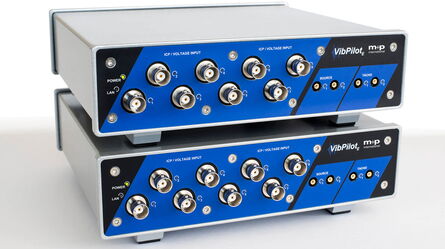
Two stacked m+p VibPilot devices feature multiple input and output ports for precise vibration testing.

m+p VibPilot - Compact DAQ systems

Choose our powerful, lightweight, and fan-less m+p VibPilot measurement front-end for all test setups with 4 or 8 channels and combinable for up to 32 channels, whether in vibration testing or in vibration and sound analysis.
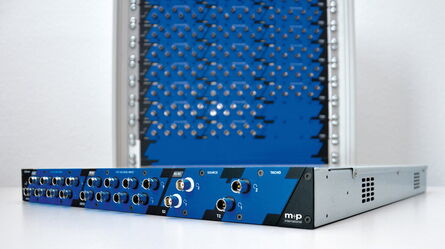
An m+p VibRunner DAQ module and a rack stacked with several modules s displayed on a white surface.

m+p VibRunner - High channel count DAQ systems

Test large structures or applications with high data throughput using our modular m+p VibRunner hardware platform that can be flexibly scaled to handle hundreds of input channels or multiple exciters.

Applications for sine control

Applications for
xxx

Useful additional modules

Excite your specimen with a real random pattern to perform more realistic simulations.

Perform transient excitations to simulate shock loads on the specimen.

Simulate environments in which random excitations are mixed with superimposed harmonic or random loads, such as those occurring in a helicopter or tank.

Expand your channel count by synchronizing your DAQ system with other vibration controllers.

Use our throughput function to have a comprehensive signal base for further processing, for analysing short-term events during the test or for troubleshooting.

Testing with heavy specimens and several shakers or excitation in 3 axes simultaneously? Coupled or decoupled? With our multi-shaker solutions, you can carry out demanding tests safely and precisely.

Identify the breaking point of your test object during product development durability tests by holding and vibrating it at its natural resonance even if the frequency shifts.

Easily visualize the deflection shapes of a machine or structure, whether in operation or on a test bench.

Protect your specimen and system from overtesting by using targeted notch control to limit vibrations.

Carry out more realistic tests with increased system safety and better protection of the vibration exciter, e.g. when testing higher structures. The essential functions for a professional force limited vibration test are also provided.

Monitor your test stands using a higher-level tool and create clarity and structure in the large variety of signals.

Handle high-frequency shaker tests on components such as control units, sensors, or gyroscopes, by increasing the control frequency from 20 kHz to 40 kHz.

Automate repetitive test sequences, such as a resonance-random-resonance search in a flexible schedule plan. This module also allows the controlled combination with external devices such as climatic chambers.

Integrate your tests into your IT environment for advanced automation and remote monitoring.

Calibrate your sensors in-house and benefit from a complete out-of-the-box system.

Easily and quickly create custom reports that meet your individual requirements.

Useful additional modules

Excite your specimen sinusoidally with a harmonic excitation to perform resonance searches or simulate harmonic loads.

Excite your specimen with a real random pattern to perform more realistic simulations.

Perform transient excitations to simulate shock loads on the specimen.

Simulate environments in which random excitations are mixed with superimposed harmonic or random loads, such as those occurring in a helicopter or tank.

Nothing is more realistic than simulating pre-recorded real signals on the test system, which is exactly what our road load simulation is made for.

Expand your channel count by synchronizing your DAQ system with other vibration controllers.

Use our throughput function to have a comprehensive signal base for further processing, for analysing short-term events during the test or for troubleshooting.

Testing with heavy specimens and several shakers or excitation in 3 axes simultaneously? Coupled or decoupled? With our multi-shaker solutions, you can carry out demanding tests safely and precisely.

Use our proven acoustic control system for a 360° acoustic excitation of the specimen – whether through loudspeakers or in a reverberation chamber.

Identify the breaking point of your test object during product development durability tests by holding and vibrating it at its natural resonance even if the frequency shifts.

If it is not possible to measure the force applied to the structure, our OMA solution offers a way to accurately calculate the modal parameters of a test object.

Understand the dynamic behaviour of structures using this toolbox for determining natural frequencies, damping values, eigenvectors, modes and much more.

Easily visualize the deflection shapes of a machine or structure, whether in operation or on a test bench.

For in-depth analysis of vibrations in connection with rotating components, this solution offers rotational speed-dependent insights into the behavior of the test specimen.

Determine the acoustic emissions of a sound source by measuring sound power according to the ISO 374x series of standards.

Precisely measure acoustic emissions and identify sound sources with their levels directly on-site without extensive equipment based on the 9614-1 and  9614-2 standards.

Convert frequencies into octave bands of up to 1/24 spacing to better understand the human perception of sound or to simplify complex data for vibration analysis.

Record and monitor temperature signals, whether during laboratory vibration tests in climatic chambers or in long-term tests.

Quantify material deformation under dynamic loads using uni-axial strain gauges and rosettes or monitor multi-axial stresses including online prediction of expected stresses.

Record transient events – whether in the laboratory or in the field – with automatic limit value overlays and a high sample rate.

Determine the potential for shock damage to your test object by using blasting tests or high-frequency SRS simulations. This module supports both in-field and laboratory setups, offering high-resolution recording and real-time SRS calculation.

Verify SRS tests on shakers in compliance with standards. You can individually adjust tests using wavelet calculation and modification, with direct compliance checks from our SRS solutions.

Benefit from extensive functions for recording various signals along with powerful methods for processing, analyzing, and evaluating your data.

Use our convenient out-of-the-box solution to accurately calculate the properties of acoustic materials, including sound absorption coefficient, reflection factor, impedance, and transmission loss coefficients.

Optimize your rotating components by correcting imbalances in one or two planes with our guided and visualized functions.

Protect your specimen and system from overtesting by using targeted notch control to limit vibrations.

Carry out more realistic tests with increased system safety and better protection of the vibration exciter, e.g. when testing higher structures. The essential functions for a professional force limited vibration test are also provided.

Monitor your test stands using a higher-level tool and create clarity and structure in the large variety of signals.

Handle high-frequency shaker tests on components such as control units, sensors, or gyroscopes, by increasing the control frequency from 20 kHz to 40 kHz.

Automate repetitive test sequences, such as a resonance-random-resonance search in a flexible schedule plan. This module also allows the controlled combination with external devices such as climatic chambers.

Integrate your tests into your IT environment for advanced automation and remote monitoring.

Calibrate your sensors in-house and benefit from a complete out-of-the-box system.

Easily and quickly create custom reports that meet your individual requirements.

Sine testing services

A man in a headset smiles while providing tech support at a computer, embodying professional assistance.

Support

We offer personalized support from experts with excellent response times, not anonymous call-centre hotlines.

A man in a blue shirt reviews a calibration certificate on a computer screen in a technical office setting.

Calibration

Choose between factory and ISO 17025 calibrations with on-site and rental services to minimize downtime.

A team collaborates around a table with electronic equipment and a screen displaying technical diagrams during a training session.

Training

Our experts help you train new employees, master new testing challenges, or optimize specific test processes.

Maintenance Contracts

Let us take care of hardware calibration and software updates so you can focus on your tests.

“Life safety and security selected m+p as our preferred vibration controller supplier for the intuitive software and competitive pricing. As a UKAS accredited test house, we expect the highest levels of system reliability, stability and support which m+p have successfully delivered with every system.”

Andrew Lawson
Laboratory Manager at Intertek
Leatherhead/United Kingdom

“Life safety and security selected m+p as our preferred vibration controller supplier for the intuitive software and competitive pricing. As a UKAS accredited test house, we expect the highest levels of system reliability, stability and support which m+p have successfully delivered with every system.”


Andrew Lawson
Laboratory Manager at Intertek
Leatherhead/United Kingdom

“Life safety and security selected m+p as our preferred vibration controller supplier for the intuitive software and competitive pricing. As a UKAS accredited test house, we expect the highest levels of system reliability, stability and support which m+p have successfully delivered with every system.”


Andrew Lawson
Laboratory Manager at Intertek
Leatherhead/United Kingdom

Case studies

Mahle Filtersysteme | DE

Engineering tests for vehicles airfiltration and engine components

Aerospacelab

A cutting-edge vibration test system

Element laboratory | UK

Shake and bake testing for aerospace components

China Electronics Technology Group Corporation | CN

Radar reliability testing

Sine control resources 

Sine Testing – FAQ

Lorem ipsum dolor sit amet. Vel quis assumenda ad iusto cupiditate nam quia nemo in Quis dolorem. Ex rerum amet qui corporis odit est exercitationem sequi.

Lorem ipsum dolor sit amet. Vel quis assumenda ad iusto cupiditate nam quia nemo in Quis dolorem. Ex rerum amet qui corporis odit est exercitationem sequi.

Lorem ipsum dolor sit amet. Vel quis assumenda ad iusto cupiditate nam quia nemo in Quis dolorem. Ex rerum amet qui corporis odit est exercitationem sequi.

Lorem ipsum dolor sit amet. Vel quis assumenda ad iusto cupiditate nam quia nemo in Quis dolorem. Ex rerum amet qui corporis odit est exercitationem sequi.


Contact our experts