

Time history recording to throughput disc
Efficiency
Record raw, unfiltered time data in parallel with vibration control – ideal for complete documentation and detailed post-analysis. With targeted channel selection and high sampling rates, you capture only the data that truly matters without unnecessary storage load.
Safety
Stay in control at all times: Schedule Time history recording (or throughput recording) to start, pause, or stop automatically, or adjust manually during the test. This ensures your critical measurement data is always recorded securely.
Flexibility
Whether sine, random, shock, or mixed-mode – Time history recording captures raw data universally. At the same time, you decide which channels to record, tailoring data volume and detail level precisely to your test requirements.
Quality
Benefit from original time data in analysis-friendly formats such as .dat (raw binary) or the m+p SOT format. This gives you full freedom for post-processing – from MATLAB to seamless evaluation in the m+p Analyzer.
Capture unfiltered raw data for deeper analysis
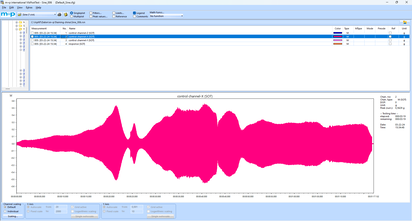
Original time data without filter effects
Throughput recording saves raw data seamlessly and unfiltered - irrespective of the ongoing vibration test. This means that all details are available for precise post-analysis, ideal for deepening the physical understanding of the specimen and test.
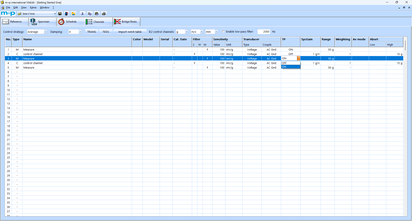
Flexible sample rates and targeted channel selection
The sample rate is freely adjustable irrespective of the test - up to 102.4 kHz per channel. Individual channels can be specifically selected for recording, which saves memory space and creates focus.
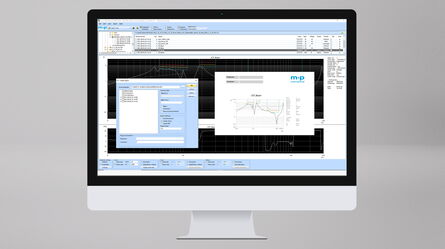
Compatible with any excitation mode
Whether sine, random, shock or mixed mode: time history recording can be used across all test types and easily integrated into complex test sequences.
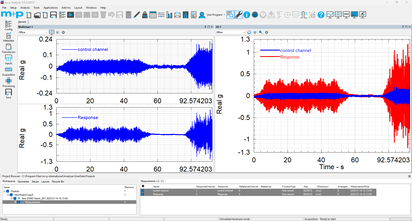
Analysis-friendly formats and seamless integration
The data is saved in m+p *.sot format for direct evaluation in m+p Analyzer and alternatively in *.dat format for easy analysis in tools such as MATLAB. The user interface and operating concept are identical to m+p VibControl - for a familiar user experience.

Update to
m+p VibControl 2.19
Discover how the new features boost
your vibration testing.
Scalable measurement hardware systems - from 4 to hundreds of channels
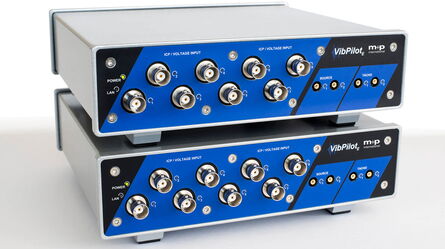
m+p VibPilot - Compact DAQ systems
Choose our powerful, lightweight, and fan-less m+p VibPilot measurement front-end for all test setups with 4 or 8 channels and combinable for up to 32 channels, whether in vibration testing or in vibration and sound analysis.
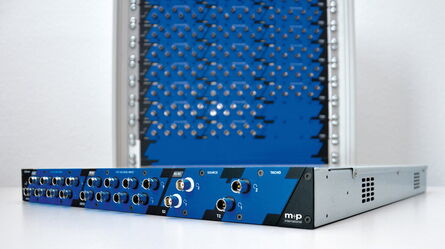
m+p VibRunner - High channel count DAQ systems
Test large structures or applications with high data throughput using our modular m+p VibRunner hardware platform that can be flexibly scaled to handle hundreds of input channels or multiple exciters.
Applications for time history recording
Services

Support
We offer personalized support from experts with excellent response times, not anonymous call-centre hotlines.

Calibration
Choose between factory and ISO 17025 calibrations with on-site and rental services to minimize downtime.

Training
Our experts help you train new employees, master new testing challenges, or optimize specific test processes.

Maintenance Contracts
Let us take care of hardware calibration and software updates so you can focus on your tests.


“Life safety and security selected m+p as our preferred vibration controller supplier for the intuitive software and competitive pricing. As a UKAS accredited test house, we expect the highest levels of system reliability, stability and support which m+p have successfully delivered with every system.”

“Life safety and security selected m+p as our preferred vibration controller supplier for the intuitive software and competitive pricing. As a UKAS accredited test house, we expect the highest levels of system reliability, stability and support which m+p have successfully delivered with every system.”
“Life safety and security selected m+p as our preferred vibration controller supplier for the intuitive software and competitive pricing. As a UKAS accredited test house, we expect the highest levels of system reliability, stability and support which m+p have successfully delivered with every system.”
Case studies

Mahle Filtersysteme | DE
Engineering tests for vehicles airfiltration and engine components

Aerospacelab
A cutting-edge vibration test system

Element laboratory | UK
Shake and bake testing for aerospace components

China Electronics Technology Group Corporation | CN
Radar reliability testing
Throughput recording resources

Time history recording – FAQ
Time history data is the raw voltage measurement of a signal , captured directly from a sensor such as an accelerometer, strain gauge, load cell, or displacement transducer. The time domain data is scaled to an (EU) engineering unit, via a sensors calibration sensitivity.
For the most critical tests time history data can be recorded in parallel with vibration control with no reduction in control performance. The real-time throughput data capture function allows you to record all selected channels continuously in the time domain on the embedded data server irrespective of the channel count and the frequency range utilized. Critical events that happen throughout a test can be recorded in its raw undeited format, which can be post processed at a later stage for further analyses.