

Multi-axis vibration control
Efficiency
Standard-compliant testing without computational effort: Specify either sweep rate or sweep duration - Sine Control calculates the rest automatically. Online transfer functions make resonance searches fast and transparent, saving you valuable time.
Safety
You can rely on maximum safety for the specimen and system: the integrated self-check detects discrepancies before the test starts, while definable shutdown times ensure a controlled and gentle shutdown.
Flexibility
Whether simple standard tests or highly complex sweep tables - you decide how much detail you want to go into. Sine Control adapts to your requirements and offers complete freedom between “plug & play” and the finest parameterization.
Quality
Rely on adaptive, frequency-based control for maximum precision in the sweep. Never lose data again - your results are fully retained even if the test is aborted. And with integrated analysis functions such as resonance evaluation and Q-factor calculation, you can quickly gain reliable insights.
Lorem ipsum dolor sit
consectetuer
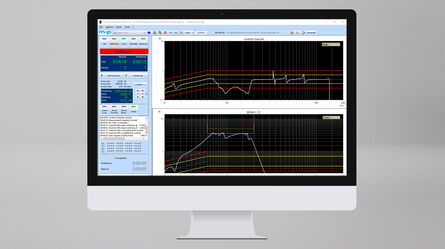
Test with ease and accuracy
Our sine control software is intuitive to use and makes even complex tests easy. Test progress is clearly displayed. During testing, you can copy data, schedule intermediate and perform manual measurements, or pause in standby mode. Adaptive time block length ensures maximum accuracy by minimizing control errors.
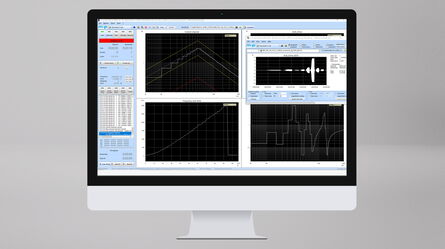
Easily interpret test data
Visualize your sine wave in the time domain and easily switch between acceleration, displacement, and velocity values thanks to online integration and differentiation. For simplified analysis, apply measurement filters for RMS, peak, averaged, or digital tracking independently or together.
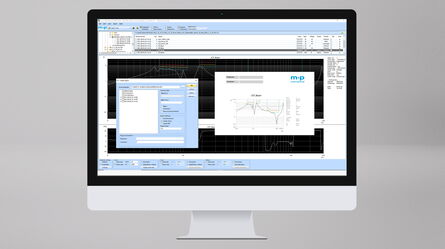
Find resonances faster
Online displays of phase and amplitude spectra or transfer functions make understanding natural resonances more convenient. You can also use these transfer functions as a reference signal to quickly detect resonance shifts online after load tests.
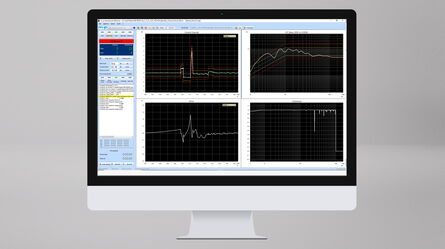
No data loss
Even if your test aborts, your results are saved, allowing you to easily continue testing without restarting. For a smooth transition you can manually adjust the signal.

Update to
m+p VibControl 2.19
Discover how the new features boost
your vibration testing.
Scalable measurement hardware systems - from 4 to hundreds of channels
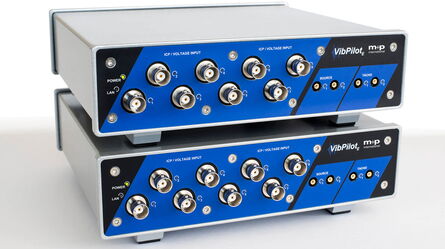
m+p VibPilot - Compact DAQ systems
Choose our powerful, lightweight, and fan-less m+p VibPilot measurement front-end for all test setups with 4 or 8 channels and combinable for up to 32 channels, whether in vibration testing or in vibration and sound analysis.
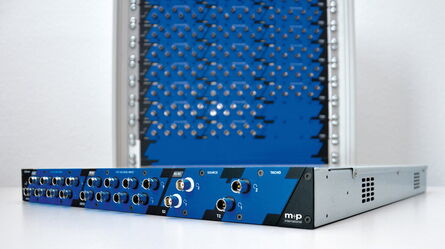
m+p VibRunner - High channel count DAQ systems
Test large structures or applications with high data throughput using our modular m+p VibRunner hardware platform that can be flexibly scaled to handle hundreds of input channels or multiple exciters.
Applications for
xxx
Services

Support
We offer personalized support from experts with excellent response times, not anonymous call-centre hotlines.

Calibration
Choose between factory and ISO 17025 calibrations with on-site and rental services to minimize downtime.

Training
Our experts help you train new employees, master new testing challenges, or optimize specific test processes.

Maintenance Contracts
Let us take care of hardware calibration and software updates so you can focus on your tests.


“Life safety and security selected m+p as our preferred vibration controller supplier for the intuitive software and competitive pricing. As a UKAS accredited test house, we expect the highest levels of system reliability, stability and support which m+p have successfully delivered with every system.”

“Life safety and security selected m+p as our preferred vibration controller supplier for the intuitive software and competitive pricing. As a UKAS accredited test house, we expect the highest levels of system reliability, stability and support which m+p have successfully delivered with every system.”
“Life safety and security selected m+p as our preferred vibration controller supplier for the intuitive software and competitive pricing. As a UKAS accredited test house, we expect the highest levels of system reliability, stability and support which m+p have successfully delivered with every system.”
Case studies

Mahle Filtersysteme | DE
Engineering tests for vehicles airfiltration and engine components

Aerospacelab
A cutting-edge vibration test system

Element laboratory | UK
Shake and bake testing for aerospace components

China Electronics Technology Group Corporation | CN
Radar reliability testing
Sine control resources

Multi-axis vibration testing – FAQ
Multi-axis vibration testing is a laboratory technique that applies vibration to a test item simultaneously in more than one direction (axis)—typically X, Y, and Z—to better replicate real-world environments.
7uIt is also called:
- 3-axis vibration testing
- 6-degree-of-freedom (6-DOF) testing
- Multi-DOF vibration testing
- MAST testing (Multi-Axis Simulation Table)
Real-world vibration is never single-axis.
A product in service experiences vibration from multiple sources at once, such as:
- Road forces from all wheels (vertical, lateral, fore-aft)
- Aircraft turbulence (all 3 translational axes + rotations)
- Machinery vibration combined with structural resonance
- Shocks from multiple directions (e.g., crash, drop)
Multi-axis testing captures these combined effects.
3-Axis Electrodynamic Shakers
- Three shakers oriented to drive X, Y, Z simultaneously.
- 2. 6-DOF Hydraulic MAST Systems
- Can move in:
- X, Y, Z (linear motion)
- Roll, Pitch, Yaw (rotational motion)
- Used heavily in automotive durability and battery pack testing.
- 3. Hexapod Platforms
- Parallel-actuator systems that replicate complex, coupled motions.