

Mixed-mode vibration control
Efficiency
Run sine-on-random, random-on-random vibration, sine-on-random-on-random, and multi-sine testing within a single interface – no switching between programs. Individual tones or narrowbands are displayed both standalone and overlaid on the broadband random profile with total RMS for quick spec checks. In multi-sine control, the frequency range partitioning for synchronous sweeps is calculated automatically.
Safety
A comprehensive feasibility check includes all superimposed components and reports both RMS and peak values. Controlled ramp-up and activation thresholds for the overlaid components prevent sudden engagement and protect your specimen and system.
Flexibility
Superimposed components can be switched on or off or adjusted with offsets. Sweeps can be configured as linear or logarithmic, synchronous or asynchronous – giving you full freedom to match your test requirements for any mixed-mode testing scenario.
Quality
All data is preserved even if a run is interrupted – Never lose data again. Superimposed components are displayed separately from the broadband random in both frequency and time domains, enabling precise comparisons to specifications and reliable documentation for long-term testing.
Safe and precise mixed-mode testing for realistic simulations
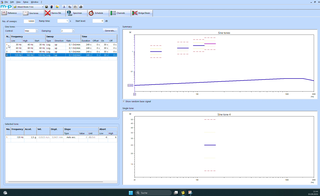
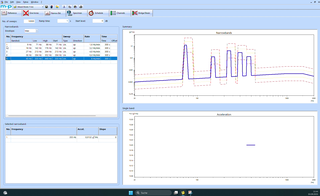
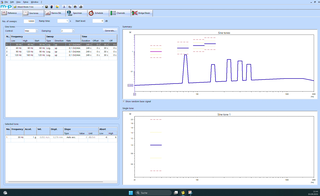
Broad standard coverage - ideal for automotive, defense & more
With mixed mode control, complex signal superpositions such as Sine-on-Random-on-Random, Random-on-Random or even triple combined excitations can be precisely controlled - compliant and flexible for numerous standards in the automotive and defense sector.
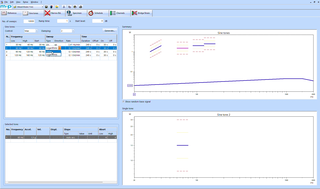
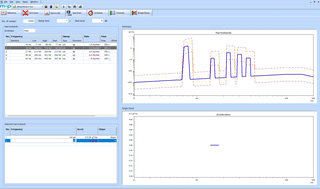
Precise control of individual components - realistic testing
Sine, broadband and narrowband random components can be configured separately: with fixed frequencies, linear or logarithmic sweep, defined slope or activation/deactivation. This allows realistic load scenarios to be simulated exactly.
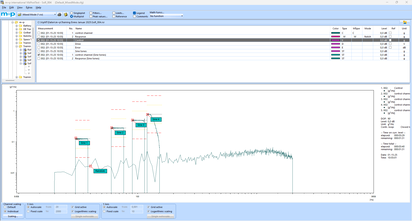
Clear separation of superimposed signals - live and analyzable
During the test, all signal components - broadband, sine and narrowband - are displayed separately. This enables an undistorted assessment of the spectrum and the individual components in real-time.
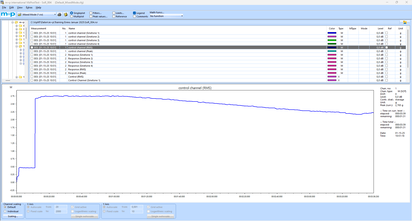
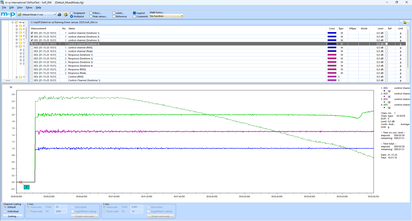
Time data analysis for maximum transparency
The display of the amplitude changes of individual sine components over time allows a detailed check of control quality and deviations - even with complex superpositions.
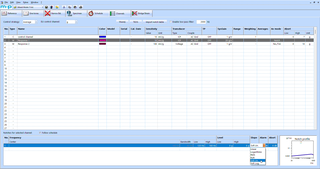
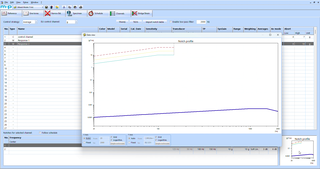
Intelligent Notching - targeted and controlled limiting
RMS values, individual sine components or entire signal ranges can be specifically limited with extensive Notching options - for safe and controlled tests, even with sensitive specimens.
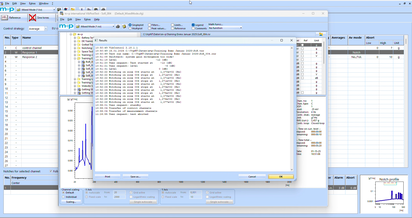
Complete documentation of all signal states
The test log documents exactly when which signal type was active. This ensures complete traceability and significantly increases the informative value of test reports.

Update to
m+p VibControl 2.19
Discover how the new features boost
your vibration testing.
Scalable measurement hardware systems - from 4 to hundreds of channels
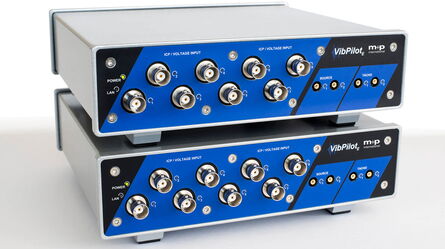
m+p VibPilot - Compact DAQ systems
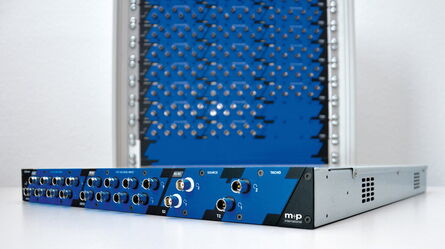
Choose our powerful, lightweight, and fan-less m+p VibPilot measurement front-end for all test setups with 4 or 8 channels and combinable for up to 32 channels, whether in vibration testing or in vibration and sound analysis.
m+p VibRunner - High channel count DAQ systems
Test large structures or applications with high data throughput using our modular m+p VibRunner hardware platform that can be flexibly scaled to handle hundreds of input channels or multiple exciters.
Applications for mixed-mode vibration testing
Mixed-mode testing services
Services

Support
We offer personalized support from experts with excellent response times, not anonymous call-centre hotlines.

Calibration
Choose between factory and ISO 17025 calibrations with on-site and rental services to minimize downtime.

Training
Our experts help you train new employees, master new testing challenges, or optimize specific test processes.

Maintenance Contracts
Let us take care of hardware calibration and software updates so you can focus on your tests.


“Life safety and security selected m+p as our preferred vibration controller supplier for the intuitive software and competitive pricing. As a UKAS accredited test house, we expect the highest levels of system reliability, stability and support which m+p have successfully delivered with every system.”

“Life safety and security selected m+p as our preferred vibration controller supplier for the intuitive software and competitive pricing. As a UKAS accredited test house, we expect the highest levels of system reliability, stability and support which m+p have successfully delivered with every system.”
“Life safety and security selected m+p as our preferred vibration controller supplier for the intuitive software and competitive pricing. As a UKAS accredited test house, we expect the highest levels of system reliability, stability and support which m+p have successfully delivered with every system.”
Case studies

Mahle Filtersysteme | DE
Engineering tests for vehicles airfiltration and engine components

Aerospacelab
A cutting-edge vibration test system

Element laboratory | UK
Shake and bake testing for aerospace components

China Electronics Technology Group Corporation | CN
Radar reliability testing
Mixed-mode testing resources

Mixed-mode vibration – FAQ
Sine-on-random-vibration is applied to test items when a unit may be subjected to multiple sine components at fixed or sweeping frequencies, while at the same time being subjected to a broadband random vibration excitation. Sine-on-random is widely used in the aerospace industry as the vibration excitation can simulate the complex vibrational environments aerospace units can be subjected to.
Multi-sine vibration testing is used when a test item needs to be subjected to complex sinusoidal vibration environment where multiple sine tone frequencies are fixed or sweeping, with each tone potentially having varying amplitudes from one another.
Sine-on-random-on-random vibration is applied to test items when a unit is subjected to multiple sine components at fixed or sweeping frequencies, with fixed or sweeping narrowband random vibrations while at the same time being subjected to a broadband random vibration environment.
To compare the damage potential of a sine vibration test versus a random vibration test, you need to translate both tests in terms of the fatigue damage, often calculated using modals like Fatigue Damage Spectra.
Fatigue damage is driven by stress cycles, not simply the input acceleration. Random tests have a broad spectrum of frequencies, which results in many cycle amplitudes. Sine tests have high amplitude but only at discrete frequencies, resulting in fewer cycles.
To compare the damage potential between a sine and random vibration:
- For a Sine test @ frequency X >convert to stress cycles > Fatigue compute damage
- Random test (PSD) > use a spectral fatigue model, such as Fatigue Damage Spectra > compute broadband damage Spectra > Find the Fatigue damage value @ frequency X
Whichever produces more cumulative damage is the more severe test.