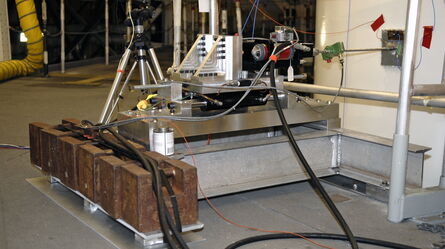
Guided and Reliable Test Setup
Selecting the right setup—roving hammer, roving sensor, shaker-based excitation, resonance dwell, or shock testing—can be difficult. Sequencing points, defining directions, and ensuring reproducibility become even more challenging in structural stability analysis or nonlinear analysis.
Our m+p Structural Testing platform guides users through the entire preparation process with wizard-based workflows. Measurement points, impact directions, and excitation strategies are clearly defined and automatically structured. Whether running Modal Analysis, Operational Modal Analysis, resonant frequency analysis, Sine Sweep, Stepped-Sine, or Shock Response Spectrum Testing, the workflow remains organized, predictable, and easy to follow.
Clean and Valid Data Acquisition
Initial excitation attempts may be unsuitable. Too little energy, too much energy, double impacts, overloads, or false triggers can compromise FFT Analysis, dynamic fatigue tests, or mechanical fatigue testing.
The Scope Mode allows users to observe the structural response without saving data. Once the excitation is correct, recording begins manually or automatically. Overloads and double impacts are reliably detected, ensuring that only valid data is retained. This creates a clean, trustworthy foundation for Modal Analysis, FFT Spectrum Analysis, structural break analysis, and Fatigue Testing.
Advanced Excitation for Structural Testing (Sine, Resonance Dwell, Shock & Burst Testing)
Structural investigations often require more than simple impacts. Engineers need to observe frequency drift during resonance dwell, evaluate decay behaviour in shock events, or excite structures with precise profiles such as Sine Burst, Sine Chirp, Random Burst, or Step-Sine. This is crucial for applications like accelerated fatigue testing, structural failure analysis, and vibration analysis of aircraft wings.
Our combined Test & Analysis environment provides advanced excitation capabilities—including Sine Sweep, Sine Dwell (Resonance Dwell), Shock Testing, SRS Testing, Sine Burst, Chirp excitation, Random Burst, and Step-Sine—with robust control and safety mechanisms. Resonance dwell provides insight into frequency shifts under load, while shock and SRS profiles reveal damping, decay, and structural behaviour under transient conditions. These results can be imported directly for deeper analysis, enabling a seamless workflow between excitation and interpretation.
Automatic Trigger-Level Definition
Choosing the correct trigger level for hammer- or shaker-based excitation can be difficult. Too low and the measurement starts prematurely; too high and valid impacts are missed, affecting structural failure analysis, resonant frequency analysis, or natural frequency analysis.
Automatic trigger calculation determines an optimal threshold based on several trial excitations. This ensures reliable force capture and prevents overloads. Together with guided calibration routines, the system guarantees consistent and accurate input data for Modal Analysis, Frequency-Domain Analysis, and Fatigue Testing.
Real-Time Quality Feedback
If coherence, FRFs, peaks, decay characteristics, or frequency-domain indicators are reviewed only afterwards, quality issues may go unnoticed until it is too late—impacting Structural Health Monitoring, Structural Analysis, or Structural Health Tests.
Our solutions offer live coherence, real-time FRFs, level monitoring, and reference tracking, allowing users to make adjustments immediately. This is especially valuable during resonant frequency analysis, shock decay evaluation, Nonlinear Analysis, and Finite Element Model validation. Real-time quality feedback ensures efficient testing and reliable structural interpretation.
Clear Modal Interpretation and Validation
Mode shapes, natural frequencies, and damping ratios must be interpreted clearly. Without strong visualization tools, operational deflection shapes, structural stability analysis, or vibration analysis of aircraft wings become time-consuming.
Our integrated structural analysis workflows include intuitive 3D mode shape animations, movable frequency cursors, and wizard-driven ODS extraction from time- or frequency-domain data. Validation tools such as MAC, MIF, phase deviation, and mass-phase collinearity provide clear insight into mode consistency—supporting Nonlinear Analysis, Fatigue Testing, and structural failure analysis with high confidence.
Complete Documentation and Traceability
Structural testing involves many variables—geometry definitions, excitation profiles, sensor placement, metadata, safety limits, dwell parameters, and shock settings. Missing documentation complicates long-term Structural Analysis, Finite Element Model updates, or transient structural analysis.
Our m+p Structural Testing environment stores all data, test parameters, and metadata within the project. Reports can include diagrams, tables, shock decay curves, mode animations, coherence plots, ODS animations, Sine Dwell trends, and setup information.
Additionally, data from vibration control sessions—such as Sine Dwell, SRS, Shock, or Sine Sweep—can be imported directly for deeper structural analysis, bridging test control and modal interpretation into a unified workflow. This ensures complete traceability for fatigue studies, structural stability, failure analysis, and long-term Structural Health Monitoring.
Structural Analysis – FAQ
What is sine testing?
Lorem ipsum dolor sit amet. Vel quis assumenda ad iusto cupiditate nam quia nemo in Quis dolorem. Ex rerum amet qui corporis odit est exercitationem sequi.
What is a sine wave vibration?
Lorem ipsum dolor sit amet. Vel quis assumenda ad iusto cupiditate nam quia nemo in Quis dolorem. Ex rerum amet qui corporis odit est exercitationem sequi.
What is better, sine or random?
Lorem ipsum dolor sit amet. Vel quis assumenda ad iusto cupiditate nam quia nemo in Quis dolorem. Ex rerum amet qui corporis odit est exercitationem sequi.
What are the limitations of sine vibration testing?
Lorem ipsum dolor sit amet. Vel quis assumenda ad iusto cupiditate nam quia nemo in Quis dolorem. Ex rerum amet qui corporis odit est exercitationem sequi.